
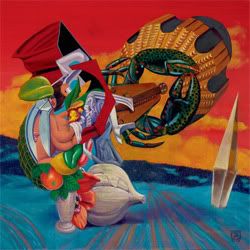
Octahedron (2009)
Reviewing Mars Volta albums feels slightly pointless. Chances are, you've already got your opinion of the band and it's not really going to change. So eff that; instead of reviewing Octahedron outright, I'll share some personal thoughts inspired by listening to Octahedron -- which will likely be barely distinguishable from a proper review, but that's neither here nor there. For what it's worth, though, I will say that this album is a slightly different beast than their recent work, and that if there is any Mars Volta album that will change peoples' minds about them, or reengage any wayward fans, then this would be it. If you were not keen on the pointlessly long solos, chaotic drumming and guitar playing, and general prog-rock indulgences, you may like what they've come up with for Octahedron. At 8 songs and 50 minutes long, this is easily their most straightforward, digestible album yet. Inversely, if you were a fan of the long solos and chaos, you may not like Octahedron all that much. And that's all I have to say about that.
I've always positioned Mars Volta as the kind of band that I would eventually grow out of. They provided some good music and memories for my younger days, but their brand of rambunctious prog-rock was surely bound to work its way through my system as the process of my maturing musical tastes simultaneously coincided with their inevitable decline in quality (though can you ever tell which is occurring faster, if at all?). It's no wonder, then, that I've approached their last few albums with a bit of hesitation, none more so than Octahedron. I saw it sitting on the New Releases wall at the record store, stacked next to new albums by Green Day, Depeche Mode, Eminem, Mos Def, Marilyn Manson, Dave Matthews Band, Iron Maiden, and other such artists past their prime (arguments on whether some of those artists ever had a prime will be heard at a later date), and wondered about the kind of people who buy those records. How much do they really expect these new albums to live up? It's not because those artists are still making classic material, I decided, but it's more of a comfort issue. The listener knows what they're gonna get. The purchase doesn't require them to take any risks and there's little uncertainty as to how it will sound. Certainly I'd never fall into such a habit, right? Right? Wrong. Because there I was, doing exactly that with the Mars Volta.
So what does it mean if I tell you that Octahedron is a great album? Or if I add that it's their best since De-loused In The Comatorium? I believe that I mean it, but there's that nagging feeling that I may merely be trying to justify my continued support of a band that many of my friends no longer listen to. That I'm not listening to them because they are still good, but because they have only done a good job at reminding me of how I felt when I first heard them when I was younger. On that note: does how much a new album reminds you of a past good album mean that the new one is good too? Is Octahedron successful in my eyes because it sounds the most like their earlier material, or because it is an honestly well-written, well-performed, and well-executed album? The more I think about it, the more I think the answer to those questions don't really matter, and that it's a lose-lose situation to try to provide a completely objective opinion of a band with as polarizing a history as The Mars Volta.
I walked out of the record store with Octahedron feeling like the oldest 25-year old in the world. I was barely anticipating that the album would be worthwhile, yet I bought it anyway, realizing that I was now able to answer my own question: Did I really expect that this new album would live up? No. But maybe it would be good enough. Good enough to remind me of the old days (that really aren't very old at this point). Good enough to satisfy me for a short time. Maybe good enough to get me to buy their next record. And if I was lucky, it would be more than that.
In my eyes, Octahedron is more than that; and even if I do just have smoke in my eyes, I suppose there are worse aspects of aging than stubbornly supporting bands that you felt like you should've stopped caring about a long time ago. Besides thinking that 90% of teenagers are fucking retarded, supporting declining bands is about as "old" as I get...at this point.
Score: 8/10
"With Twilight As My Guide"
"Desperate Graves"
Friday, August 7, 2009
The Mars Volta - Octahedron (2009)

Tuesday, July 21, 2009
Ya Ho Wha - Penetration, An Aquarian Symphony (1974)
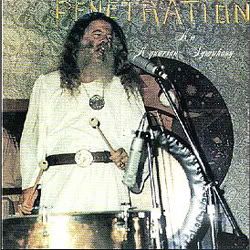
Penetration, An Aquarian Symphony (1974)
Living very literally up to the phrase "cult" band, Ya Ho Wa 13's recordings are the product of California's Source Family, one of the more well known and slightly less creepy hippie communes formed during the 1970's. Led by well-traveled weirdo Jim Baker (a.k.a Father Yod a.k.a Ya Ho Wha), the Source Family gained a large following which consisted of many musicians. With profits garnered from their popular vegan organic food restaurant on the Sunset Strip, the group recorded albums in a soundproof garage, completely unrehearsed in the early morning hours, and sold them in their restaurant under the name Ya Ho Wa 13.
Abstract. Meditative. Improvisational. All descriptions apply here. As such, I'm having trouble coming up with a review of something so thoroughly trance-inducing in nature, because with albums like this, the whole is always greater than the sum of its parts. Sure, I could probably talk about the haunting quality of Father Yod's nonsensical howling or the rhythmic taiko-like beat that is complimented by meandering psychedelic guitar strums, but I couldn't do so without sounding like a complete and udder tool. The songs are not really individual songs, but mere separations to mark the ends of certain movements before changing course slightly and building on a new rhythm. There are no individual moments. Swallow this one whole and enjoy. I'm sure there was a similar mindset going around within the Source Family (OOOOOHHHH!).
Score: 7.5/10
"Ho"
Saturday, June 27, 2009
Selda - Selda (1976)

Selda (1976)
The aging hippie at the register when I bought this while on vacation in Portland was totally unimpressed. I mean, I'm sure I'm not the only motherfucker who's ever come in there looking for Turkish rock, but certainly I'm one of a very small number, right? Right? "Oh yeah, Selda. Good choice. I really like the stuff she did later on that was just super avant garde, experimental psychedelic stuff. You should check it out. This one's more pop, but it's still good." Well, fuck you too, aging hippie. Sure, most people wouldn't have caught your subtle jab at my musical selection, but I'm on to you, buddy. Don't think I don't know what you meant by "pop". The word has resulted in fisticuffs between hardcore record elitists on more than one occasion. It's the equivalent of throwing down the gauntlet; a quick way of communicating that your musical tastes are waaaay more esoteric and that the challenger's attempts to dethrone you are admirable, yet weak. Fine, you win this round. I'll take my "pop" record, thank you very much, and maybe I'll rip it to my computer and put it on my iPod so I can listen to it while I'm at my job THAT ACTUALLY PAYS WELL AND PROVIDES HEALTH INSURANCE! Yeah. Maybe my wife will like it, too. That's right, I bet you don't have one of those either...dick.
Selda Bağcan was one of the premiere artists of the Anatolian rock movement in 1970's Turkey, which combined traditional Turkish folk with western-influenced rock (and even a bit of funk). She's the first artist who's music I just had to hear more of after I got rather addicted to the Turkish Psychedelic Music compilation courtesy of the good guys responsible for the Love, Peace & Poetry series. Hearing "İnce İnce Bir Kar Yağar" -- found both on this album and on the compilation -- it was hard not to be taken with her grating, raw, powerful vocal style. The sick, fuzzy saz riffs didn't hurt either, and luckily they're all over this album, because I love them. Just sick, fucking fuzz riffs all over the goddamn place from the first track on. Actually, the first track might have the best one; there's this one part where she stops singing and everything drops out, and she just starts shredding this hard ass fuzzy solo as if to say ,"Yeah, I'm kind of a badass", and I can't do anything but agree wholeheartedly. While there's certainly a good amount of fuzz, the album is actually pretty varied, with a couple of beautiful ballads that aim for use of softer instruments (like the silky violin-led "Dam Üstüne Çul Serer") as well as a few that incorporate some early electronics in with your traditional rock instrument fare.
Of course, it's all going to come down to her voice for most people. Selda's not exactly what you'd call a classically trained singer, and frankly, sometimes her voice can sound like very bad karaoke from a little boy, mid-tantrum. But dammit, she puts her heart into it and that's all I care about. A known political activist in Turkey, Selda's songs often contain politically charged lyrics that criticize government and military, and speak for the oppressed, struggling working class. Openly calling herself the "bitter sound of Turkish people", her vocal limitations aren't lost on her. Obviously, it doesn't bother me. She does a bang-up job conveying the emotions of the people she's speaking for, and sometimes what they have to say or how they say it isn't pretty. Let it bother you if it must, but you'd miss out on a great album in the process.
Score: 8/10
"Mehmet Emmi"
"Dam Üstüne Çul Serer"
Friday, March 27, 2009
Love, Peace & Poetry: Turkish Psychedelic Music (2005)

I didn't really notice how criminally absent Turkish music was from my collection until I heard this album; or how little I knew about Turkey as a country; about its history and its people. With the ninth installment of the Love, Peace, and Poetry compilation, which explores obscure world psychedelic music, Normal Records and QDK Media have opened my eyes. Does that mean that, thanks to this compilation, I can now give you a detailed synopsis on Turkish history, pop culture, and current events? Nope, but I can damn sure assume that their musicians in the 70's must've had some pretty potent drugs at their disposal.
Though the album is subtitled Turkish Psychedelic Music, the songs on here can more accurately be described as Anatolian rock, which was the name given to music that fused traditional Turkish folk with Western-style rock. Despite following in the footsteps of popular American and British psych bands, the songs on this compilation, with its infusion of traditional Eastern instruments, is actually more deeply representative of what most people today would classify as true psych rock. It's hard to argue this when listening to songs like "Yağmur" by Erkin Koray -- an artist that the liner notes calls "the most psychedelic rocker ever from Turkey" -- or the lead-off track "Bundan Sonra" by Selda, who contributes to two songs to the compilation. Her other song, "Ince Ince Bir Kar Yagar", is my favorite track on the album. It's a traditional türkü arrangement with strong political lyrics that I don't understand a word of, but the emotion of her often harsh delivery easily gives away the songs' urgent and deeply personal tone, which somehow allows me to look past the grating quality of the vocals.
Overall, this Love, Peace and Poetry collection should appeal to any fan of psychedelic music. It's a collection of music so strong that it's singlehandedly sparked my interest in the culture from which it came. Another demonstration of the power of music, I guess.
Score: 8.5/10
"Kara Yazi"
"Ince Ince Bir Kar Yagar"
Friday, March 20, 2009
Os Haxixins - Os Haxixins (2009)
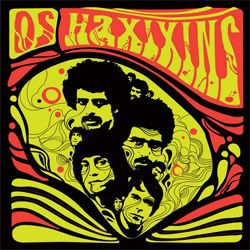
Os Haxixins (2009)
If there's one age-old query that can be answered by listening to Os Haxixins' self-titled debut, it is this: what happens when a group of stoners get their hands on a vintage organ? Welp...here ya go! Add in some vintage amps, guitars and lo-fi recording equipment and you have yet another band that was formed forty years too late. They certainly aren't the first band to follow this trend but, considering my favorite album last year was from the Swedish psych band Dungen, this is one trend I personally don't mind bands following.
With a look as vintage as their sound, Os Haxixins made a name for themselves playing around São Paulo for four years before they got around to actually recording. Originally release as a vinyl-only album in Portugal in 2007, this CD reissue comes to us courtesy of Pittsburgh's Get Hip Records, complete with two bonus tracks (the instrumental "Raios" and "Please Forget", one of three English language tracks); but unfortunately absent of any clues as to how to actually pronounce the bands' name. Few things make me feel so incredibly gringo than trying to say it without struggling, but I've settled on either "os hazizins" or "that one Brazilian band I've been listening to". Both seem to get the point across.
Though there are certainly psych elements to Os Haxixins sound, the fuzzed out guitars, slightly muffled vocals, and catchy two-minute song structures place them more in garage rock territory. And as discussed, all of the songs, for better or for worse, are dominated by the organ. This isn't necessarily an automatic flaw as they actually use it quite well most of the time, adding a dimension to their sound that many similar bands lack. They can rock out with it, as they do on the opener "Onde Meditar (Imi-dà)" and on the excellent "Àcido Fincado", or they can do a more laid-back, spy music feel, as on "Depois Eu Volto (Gimme)". But their options, or perhaps just their ideas, are somewhat limited with the instrument, and throughout sixteen tracks of organ onslaught, it starts to sound a little redundant.
Overall, though, Os Haxixins is a pretty enjoyable listen that's true to the band's garage rock influences: fun, fast and loud, even if lacking a little depth.
Score: 7/10
"Depois Eu Volto (Gimme)"
"Àcido Fincado"
Wednesday, March 4, 2009
...And You Will Know Us By the Trail of Dead - The Century of Self (2009)
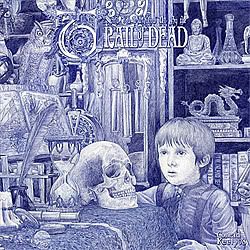
The Century of Self (2009)
So....how 'bout those Detroit Pistons, eh (stay with me, non-sports fans)? Admittedly not a team I payed a lot of attention to before the 2004 NBA Finals, where they faced off against a juggernaut of a Los Angeles Lakers team, which featured arguably the greatest coach (Phil Jackson), center (Shaq), clutch shooter (Robert Horry), and post-Jordan all-around player (Kobe) all on the same side (well, for the most part). The debate surrounding the matchup wasn't so much whether the Lakers could capture their fourth title in five years, it was how many games it would take them to do it. The Pistons, however, had other ideas. They not only beat the Lakers, they methodically destroyed and embarrassed the Lakers to such a degree that it prompted one journalist to refer to the series as "the five-game sweep" (the Lakers barely eeked out one win thanks to the last-second heroics of the aforementioned Robert Horry). Almost overnight, everybody in the NBA was paying attention to the Detroit Pistons.
The Pistons weren't by any means a flashy team with any outstanding players doing exciting things, they were average or above average players who happened to be outstanding when together. After the Pistons carried their momentum all the way to the seventh and final game in the next years' NBA Finals (where they fell to the Spurs), the next two off-seasons would see them lose both their head coach and star center respectively, something they never quite recovered from. And while they were still winning games and having flashes of brilliance, they had gotten noticeably comfortable and complacent, failing to turn it on when they had to. They often appeared so bored with the idea of a basketball regular season that they hardly seemed to care by the time it mattered most: the playoffs. Today, the Pistons are becoming farther and farther removed from the days among the Eastern Conference's elite teams, so thoroughly muddled in an obvious period of transition and rebuilding that only a glimmer of their past glory remains while a hope for future dominance is on the horizon; though at this point, just barely so.
I don't really have to spell this out for you, do I?
If I were to grade The Century of Self on its first fourteen minutes, I would be hailing the bands' sudden return to form, praising them for successfully melding the energetic songs of their past with the bloated, often melodramatic arena rock sound they've attempted on their more recent efforts. Following the buildup track, "Giant Causeway", "Far Pavilions" sounds plucked straight out of the Madonna/Source Tags-era of their career; the loud-soft-loud dynamic pulled off as successfully as they used to do it (before the soft parts started feeling like awkward, confused transitions to extend the song length). The album then jumps straight into the dramatic magnum opus "Isis Unveiled". I'll spare the fancy wording: this song fucking kills. Yeah, it sounds suspiciously Muse-like (I spy a "Knights of Cydonia" inspiration), but it makes up for any faults with sheer aggression. This is the least lethargic they've sounded in years.
But the album goes on, and proceeds to hit an immediate road block in "Halcyon Days", which isn't a bad song, but feels right on par with Trail of Dead's recent output -- and as you can guess, this isn't a compliment. Luckily, the band gets things rolling again with a trio of good tracks in "Bells of Creation", "Fields of Coal", and "Inland Sea". With these songs ("Fields of Coal" most notably), it's obvious the band, of which the founding members are now well into their 30's, have somewhat regained that certain youthful energy that seemed to drive their earlier work. They're having fun playing again, and I feel young again listening to them.
Regrettably, they can't keep it up to close the album. With a series of forgettable tracks (save for "Luna Park", which is memorable only because it's the most obvious failure: an attempted piano-driven soft-rock ballad), The Century of Self ends with a bit of a whimper. In the end, it's hard to classify whether this album is a success or not. It's most definitely better than their last album, So Divided, and many would agree that it also tops 2005's World's Apart (I'm one of the few that would debate this). It certainly isn't Source Tags & Codes, but at this point no rational person expected it to be so.
My personal vote is to consider it a marginal victory. So Divided was a mess so difficult to defend that I was ready to give up on the band altogether. With The Century of Self, they've shown enough progress to convince me to stick with them through their arduous restructuring process. Like the Pistons, I'll continue to watch their development and hope for the best, but I'll be less surprised if they don't come through when the game's on the line. There's always next year, anyway.
Score: 6.5/10
"Isis Unveiled"
"Fields of Coal"
Friday, January 23, 2009
The Walkmen - You & Me (2008)
The Walkmen
You & Me (2008)
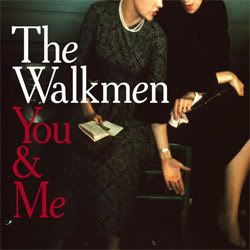
Everyone Who Pretended To Like Me Is Gone, the Walkmen's debut, seemed to give the air of being the calm after a storm that we weren't around to witness; thriving on minimalism and distance, and was equal parts stark and optimistic. I suppose it's only natural that the sound on You & Me, their fourth proper album, is similar. The storm this time having been their previous album, A Hundred Miles Off.
And on that subject, I must say that I think A Hundred Miles Off got a bad rap. Many of the complaints about it seemed to focus on the voice of lead singer Hamilton Leithauser, which often sounded strained and hoarse. I always saw it as a part of an energy to that album that I think went under-appreciated; part of the excess that I felt the album was going for from the start. There was a wildness to it; not really a dance or a party album, just a loud one. The drumming was more frantic, the guitars mixed higher, the percussion used more gratuitously while the toy piano collected dust along with all of the other novelty instruments that previously complemented the bands' sound. Because they weren't fucking around this time.
All signs seemed to indicate that they were giving it all they had, vocal chords be damned ("He lost his voice, but he's all right", he sings on one track), and when it was over, I felt that I'd heard the last of the Walkmen, because I couldn't imagine that they had anything left to give. I awaited the announcement of a break-up or hiatus, ready for my hunch to be proven right. Instead, we got announcement of a Harry Nilsson cover album, a book, and eventually, You & Me.
The aforementioned similarities of this album and their first are many. Despite its spring release date of March 2002, Everyone Who Pretended To Like Me Is Gone (EWPTLMIG from now on) always struck me as a rather wintry album. Same with 2004's Bows + Arrows, now that I think about it. The songs evoke a certain coldness; images of snow and ice, both obvious ("The Blizzard of '96", "No Christmas While I'm Talking", "The North Pole") and not so obvious. The lyrics feel like a product of cabin fever, with themes of reflection, dreams and resolution. The sound carries as if played in a cold, empty room on a cold winter night. The crisp guitars and piano keys created, for lack of an ability to explain it better, a frosty feel. The sound on You & Me more or less continues this trend, but still sounds fresh rather than a weary band just trying to recapture past glory. These are theme songs for December in the Midwest.
The only flaw, which is inherited from EWPTLMIG, is that it's a couple of songs too long. The opening notes of "I Lost You" leave me wondering why the album is still on, and by the time "If Only It Were True" comes to a close, it's a welcome event, since I'd already sort of lost interest in the album six and a half minutes ago. That aside, another success for one of the better, more consistent indie rock acts out there.
Score: 7.5/10
"On The Water"
"Canadian Girl"
Monday, January 19, 2009
Group Inerane - Guitars From Agadez (Music of Niger) (2007)
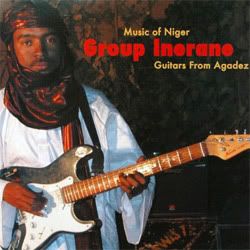
Guitars from Agadez (Music of Niger) (2007)
Guitars From Agadez earned me like 5,000 Hipster points one day during a discussion I was having with a friend about what we were listening to lately. The fact that I was able to say that the last album I got was a tribal guitar album from Niger thoroughly pummeled the living shit out of his talk of his recent Liars downloads. It was a moment that hipsters dream of (and probably plan for), and I'm sure he assumed that I had been anticipating that conversation for days, which may or may not have been accurate.
This album has a lot going for it besides being a good hipster conversation piece that will undoubtedly display how cultured and diverse your musical taste is. The cover depicts a Tuareg man holding a guitar, standing on his tribal grounds lit with the unmistakable glow of campfire. The recording quality is such that it feels like you're right there with him and his tribe, celebrating whatever they're celebrating, admiring his bluesy riffs, clapping along as you watch the women dance around the fire; maybe feeling emboldened enough to get up and dance yourself. It's a very intimate recording style; others may just call it shitty, and it is, but a studio wouldn't have done it justice.
But the honeymoon period with Guitars From Agadez is brief, and the flaws are hard to brush off. First of all is its repetitiveness. Don't be fooled by the fact that this album is split into ten individually named tracks, because they are all essentially the same song. It's a pretty good song and all, but not that good. Not good enough for it not to get a little boring towards the end. Or to not notice that the riff in one track is all but identical to the riff like three tracks ago (or five tracks ago). Or to not get a little annoyed by the constant shrill, fluctuating tribal yell that one woman seems to like doing RIGHT INTO THE GODDAMN MICROPHONE just to make sure you hear it, even though it's probably loud enough on its own for me to hear it all the way from the Sahara to where I sit now in Arizona.
So when it's all done, Guitars From Agadez comes off as sort of a nice novelty for anyone's music collection, but probably not one that I'll find myself coming back to with any sort of regularity.
Score: 6/10
"Ano Nagarus"
"Tenere Etran"
Wednesday, January 14, 2009
Les Rallizes Dénudés - '77 Live (1991)
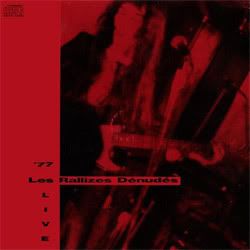
'77 Live (1991)
Before there was Boris or Keiji Haino, there was Les Rallizes Dénudés. While that alone might be enough to pique some peoples' interest in this band, they also have an interesting backstory.
According to Wikipedia (so take this with a grain of salt), the original bassist of the band, Moriaki Wakabayashi, was a member of the Japanese Red Army: a far-left terrorist group responsible for, among other things, the 1970 hijacking of Japan Airlines Flight 351 (also known as the Yodogo Hijacking). The nine hijackers, including Wakabayashi, forced the plane to fly to Seoul, South Korea, where the 122 passengers were released unharmed. They then they flew to North Korea, where the flight crew was released, also unharmed, and the hijackers were offered asylum by the government.
The hijackers had apparently taken over the plane armed with katanas and a bomb. Had they waited seven years, they probably could've pulled off the same feat simply by blasting the piercing, eardrum destroying guitar feedback of '77 Live. Above all else, I'd like to mention that this is one of those convenient cases where the album title tells you the most pertinent information about the music, which saves me the trouble of having to do so and exacerbates laziness thusly. Had they named it '77 Live Loud Japanese Psychedelic Noise Unfriendly To Ears But Still Number One!, then this review would've been over a long time ago.
As far as the music goes, I'm certain that there aren't many albums both as pleasant and unpleasant to listen to as this one. These six, aimless yet engrossing jam sessions, spread out over two disks, is pretty much can't miss for fans of noisy, experimental psych rock. But while the music pulls you in, the noise, reaching shrieking high frequencies at times, may push you away. Unless tinnitus sounds appealing to you, this is not what I would call a headphone album. The brothers Takashi (Takashi Nakamura and Takashi Mizutani, who probably aren't actually brothers but are still not above me giving them cutesy nicknames) provide a guitar attack so fierce and drenched in in high-pitched feedback that I'm not sure if this album would be medically recommended to listen to all in one sitting.
I know I can't manage it (I can only handle one disk at a time), but those that can are in for an intense, overwhelming, and otherworldly listening experience. Just watch the volume on your speakers and don't say I didn't warn you about the ringing in your ears afterwards.
Score: 8/10
"Memory Is Distant" (excerpt)
Tuesday, December 16, 2008
The Mars Volta - Bedlam In Goliath (2008)

The Mars Volta are one of those polarizing bands that I can't help but pull for to make that one album that will prove to their detractors that they're more than just fancy guitar work, precise drumming, and pretentious prog-rock wankery. For the past few years, it's been a tough sell.
Since captivating new fans and winning over a large amount of leftover At The Drive-In addicts with their 2003 debut, De-Loused In The Comatorium, the band have lost more support than they've gained. Frances The Mute, a monstrous and sometimes meandering album full of epics, threw a lot of people off the bandwagon. Amputecture didn't do much to bring them back (though I personally felt it got a bad rap). As a result, anticipation over The Bedlam In Goliath didn't reach anywhere near fever pitch, and perhaps this worked in the band's favor. Disillusioned fans of the band should take a second look: the Mars Volta have recorded their best work since their debut.
The Bedlam In Goliath features some of the most digestible song lengths and memorable melodies that the band have given us since De-Loused. It's hard to believe, but they're actually catchy again. "Ilyena" is a prime example, probably one of the finest things they've ever done with five-and-a-half minutes."Wax Simulacra", length and hook-wise, is actually radio-friendly and worthy of its recent Grammy nomination and, considering its competition, a Grammy win. "Goliath", the album's clear standout, is HUGE, reaching or even surpassing some of the most beloved songs on De-Loused like "Inertiatic ESP" or "Roulette Dares (The Haunt Of)". And that's just on the first half of the album.
The second half is hard-hitting and relentless, surprisingly free of filler. "Soothsayer", with it's middle-eastern vibe, is a successful experiment that works well for the band. The stop-start dynamic of "Askepios" provides an interesting twist. "Ouroboros" is a lightning quick, thumping track that shows off new drummer Thomas Pridgen's enormous talents. Bedlam reaches a point where it's only flaw may be that it has too many such tracks, and the band didn't want to leave any of them off even if the album becomes a little overwhelming as a result.
On the other hand, I can understand how it would be hard not to want to show off Pridgen, a child prodigy-turned-virtuoso and widely respected master of his craft. It likely is his muscular drumming that's responsible for the Mars Volta's new energy. At 25, he's the youngest member of the band, and perhaps that youthfulness is what inspired the band to act and play more like their 2003 selves; kind of like what happens when a man far-removed from his college days finds himself conversing with a young student and rediscovers the joy of the random stupid an inane behavior that he thought he'd grown out of.
In that sense, The Bedlam In Goliath reminds me of my own college days, which is probably part of the reason I enjoy it. It's basically De-Loused In The Comatorium with lyrics that make sense, taking me back to those days in the summer of 2003 when my college friends and I would throw De-Loused into the stereo and rock out, singing "EXO-SKELETAL JUNCTION AT THE RAILROAD DELAYED!" without much of a care in the world (yeah, we were pretty lame). But therein lies Bedlam's most frustrating quality: it's like hearing that album's proper follow-up five years too late.
Score: 7.5/10
"Ilyena"
"Goliath"
Monday, December 8, 2008
Aimee Mann - @#%&! Smilers (2008)

Aimee Mann - @#%&! Smilers (2008)
I've always been a fan of Aimee Mann from a distance. First having been exposed to her music by way of the movie Magnolia -- directed by her friend Paul Thomas Anderson; and also one of my favorite movies of all-time -- I came to like her brand of mature, insightful songwriting and simple but catchy melodies...from a distance. Her new albums were released and were continually met with critical praise, and I would read about them with interest thinking "Hmm, I like Aimee Mann, I'll have to pick this up", a thought that, for one reason or another, was never met with action.
@#%&! Smilers was bound to have similar fate until, as luck would have it, my part-time bookstore job was giving away a promo copy of the album after it's life as an in-store play had expired. While liking Aimee Mann and actually going out and buying her album for some reason proved too much of a task for me, liking Aimee Mann and taking home a free copy of her album was quite easy.
The album is every bit as solid as I would have expected from her. More simple but catchy ballads about life and love, beautifully sung and written with wit and wisdom. Songwriting has never been Mann's weakness, though. While her songs may strike more of a chord with a demographic I can't possibly relate to as a man in his mid-twenties, she writes them in such a way that any listener can find common ground. "Thirty One Today", for example, is a clear standout; probably one of the few modern songs that both you and your mom would enjoy equally. I imagine this would be my theme song if I were a woman in my thirties, but even now I can relate to its more general themes of disappointment and uncertainty. Her sound has expanded a bit with the use of a synthesizer, among other instruments such as horns and strings. The synth gets a little too 80's for comfort at times, as on "Borrowing Time", but typically it's not a major distraction from the composition as a whole. Overall, @#%&! Smilers is completely worth the time to listen to...as long as you can get the motivation to listen to it.
That's the thing about Aimee Mann's music: it's not really demanding of your attention. It's not remarkable or experimental. It's submissive and unoffensive enough to be played in a bookstore, obviously. Even Mann herself is kind of plain in such a way that if she took a step backward she might melt into the wall (to paraphrase Murakami). But these aren't flaws as much as they are oddly charming once you recognize them. It might've taken a stroke of right-place-right-time luck for me to finally do so, but I'm glad I did.
Score: 7.5/10
"Phoenix"
"Thirty One Today"
Friday, November 7, 2008
Nine Inch Nails - The Slip (2008)

The Slip was released earlier this year for free via the Nine Inch Nails website, mere months after the free release of the four-disc/part Ghosts I-IV album. I was never really a NIN fan growing up, but if someone's going to give away their music for free on the internet, then why the hell not see what it's about, ya know? I was a bit underwhelmed by the dark ambient meandering of Ghosts, so I wasn't expecting much from The Slip. But I must say, I'm really surprised by how not terrible this album is. More than that, I'm surprised by how good it is.
Having laid off the drugs and no longer content with being the musician of choice for cutters and goth kids, Trent is much more upbeat these days. The Slip seems to be along the lines of the more recent NIN albums (and to some extent, similar to the Reznor produced album The Inevitable Rise and Liberation of NiggyTardust! by Saul Williams), so there's electro-industrial pop aplenty. But the songs feel more confident this time out than what I've heard of him recently. The pacing of the album is effectively managed. Save for the largely pointless and barely audible opener "999,999", the album starts off fast and upbeat, then slowly brings the mood down to darker territory as the album progresses. So while "Letting You" and "Corona Radiata" have very little in common, the journey that takes you from the former to the latter is nearly flawless in it's fluidity.
It's nice to see that an artist who has embraced music's digital age as readily as Reznor (which usually includes embracing the A.D.D. listening habits associated with it) is still giving great care to the craft of an album. At 43-minutes, The Slip is less than half the length of Ghosts I-IV. If he continues to trim the fat this well and doesn't indulge too much into ambient territory, I'd happily pay for the next NIN album.
Score: 7/10
"1,000,000"
"Echoplex"
Friday, October 31, 2008
Valet - Naked Acid (2008)

Acid trips. Marijuana leaves. Dark rooms illuminated by lava lamps. The New Age book section. Dreadlocks. Grateful Dead posters. Tie-dye shirts. Sun dresses. Birkenstocks. The entire city of Sedona, Arizona. The word "ethereal". People who talk slow. Body odor. Overgrown facial hair. Arthur Magazine. Harold & Kumar Go To White Castle. Incense. That one episode of the Simpsons where Homer eats the Guatemalan chili peppers at the chili cook-off. These are just a few of the things that come to mind when listening to he free-form, psychedelic soundscapes on Naked Acid.
This is such a stoner album that I'm not sure that listening to it sober really gets me to the heart of it. But from a sober standpoint, it's not too shabby. The first three songs work especially well. The aptly named "We Went There" opens the door to the otherworldliness of the album, "Drum Movie" eases you into the new environment, and by the time "Kehaar" comes around, you're completely settled in and enjoying the ride.
Ironically enough, things start to fall apart with the song "Fuck It": a confusing, meandering song that goes nowhere and leaves you frustrated afterward (I'll spare the innuendo). From there, Naked Acid is never quite able to regain it's footing. Perhaps like any relationship built around drugs, you soon realize that there wasn't much substance there to begin with (substances, yes, but not substance). "Fire" sort of begins to pick up the pieces, but only if you're still in the mood to pay attention by that time.
All in all, a decent effort. Though I can't help but imagine how much better it would've been had Valet laid off the hash a little.
Score: 6/10
"Kehaar"
"Fire"
Monday, October 27, 2008
Dungen - 4 (2008)

Sweden's Dungen is the best psych band to appear since the genre's heyday in the 60's. I'd acknowledge the boldness of that statement, but when you consider their consistency and their competition, it's not such a grand statement at all (and if you disagree with me, I'd really appreciate recommendations for who is better). Hell, I'd argue that calling them the best current psych band is too limiting. Already with one modern classic under their belt this decade in Ta Det Lugnt, 4 is yet another solid release for a band that once again deserves album of the year consideration.
4 is, in a word, stoooooooooooooonned. The lush, hazy sound that the band played with on their previous album, Tio Bitar, returns here. It's a unique sound, rocketing you into the mood of the golden days of the psychedelic era, inducing imagery of smoke-filled rooms with shag carpeting, tacky orange wallpaper, wood paneling, and Eames chairs.
As far as vocals go, singer Gustav Ejstes only bothers with lyrics for half the album, while the remaining songs allow the instruments to speak for themselves. Ordinarily, this sort of back-and-forth format can be distracting, creating a mood where the listener just waits for the typically more interesting vocal tracks to play. Not so with 4. The songs work and blend together nicely, with the more psych pop-oriented tracks fading into in medias res jam sessions. Guitarist Reine Fiske is a true guitar hero, his virtuosic abilities carrying many of the compositions on his back, making the respectable 37-minute album length feel much too brief.
With 4, Dungen have cemented themselves into my personal "Bands/Artists Who Can Do No Wrong" stable. It's an album that should make more than a couple of top ten lists this year. It'll certainly make mine.
Score: 9.5/10
"Det Tar Tid"
"Fredag"
Friday, October 24, 2008
The King Khan & BBQ Show - The King Khan & BBQ Show (2005)

During the whole garage rock revival era of the early twenty aughts, many
And there is much awesomeness indeed. "Waddlin' Around" sounds so much like a hit rock song from the 50's that I'd think that was when it was recorded if I didn't know better. It more than just rocks, it's got soul, like old-school rhythm and blues-style soul. Setting the mood emphatically, King Khan maintain the quality for the entire album, from the surf rock riffage of "Fishfight" or "Bimbo's Theme" to the crooning of "Love You So" or balladry of "Am I The One" or the dancy "Shake Real Low". These songs are so damned old school-sounding you can almost smell McCarthyism in the air when listening to them.
One of the few albums I've heard that benefits from poor production, The King Khan & BBQ Show is pretty much an all killer affair that probably would've suffered slightly (songwriting ability should be taken into account, of course) had they been afforded the cleaner, major label production of their peers. Funny how that works out.
Score: 8.5/10
"Waddlin' Around"
"Love You So"
Friday, October 3, 2008
TV On The Radio - Dear Science (2008)
 TV On The Radio - Dear Science (2008)
Dear Science TV On The Radio,
I'm just going to come out and say it: you've changed. You used to be so full of life, full of potential. You were passionate, I liked that about you. But now...you just seem lost. You display the same old traits on the outside, but on the inside, I feel like something isn't right. Sometimes I swear that you're back to your old self, but just as quickly as the old you comes, it leaves again. And frankly, I'm not sure if I can handle a relationship like this anymore.
That's harsh, I know, and I don't mean to sound unsupportive. I wish nothing but the best for you, always. Please remember that. I've heard your new album. People really seem to like it, and I'm glad. Seriously, I'm glad you're reaching people and getting them excited. That's awesome. Not many people have the ability to do that, to do what you do. You should be proud. Hey, I'm proud of you. But deep down, I think you and I both know that your heart's not in it. This is easy for you. It's like you're not even trying anymore; like your fire is gone. What happened to that adventurous attitude you used to exude? The one that made you want to experiment with your art and take risks and push the envelope? I miss that about you.
I think we would both agree that this relationship hasn't been the same since Cookie Mountain. That hurt me, but even though it took me a long time, I was able to forgive you. Still, the relationship became strained, almost forced. I tried to keep reminding myself of the bright spots, like "A Method" or "Dirty Whirl", and it worked well enough for me to actually start looking forward to Dear Science. But when I listened to it, I just knew that it was over. Mentally, I knew that I wasn't going to be capable of sustaining this anymore, holding out hope that we'd be able make things like they used to be.
I tried to focus on the good times again, such as what you did with "Crying". It's really great; sort of like 80's R&B, pre-New Jack Swing era (am I crazy, or do I detect a little inspiration from the Commodore's 'Night Shift"?). Or how about that prog-funk you did with "Red Dress" and the dark gothic post-punk sound of "DLZ"? That's good stuff. I love it when you take risks like that, but everything else just sounds the same as usual. It's like you're so reluctant to leave your comfort zone, even though we usually have the most fun when you do. I need excitement in my life, TVOTR, and though I hate to say it, you've become boring and predictable. Like, what's with the tacked on string section that you used to provide the crescendo for not one, not two, but three different songs!? C'mon! Other indie bands add string sections as a crutch to make their boring music interesting. I thought you were better than that. You used to be better than that.
It's so sad, because even at your worst you're still better than most, yet for some reason you seem so content with aiming low. It's frustrating, because I know that if you really wanted to, you could be one of the most exciting and innovative modern soul/funk/R&B acts to come along in decades. Hell, you could defy classification and be in a genre all your own! I know you can, your first album hinted at that potential. But instead you just settle for being a mediocre indie rock band, and I don't understand why. I just can't bear seeing such talent wasted any longer.
I'm sorry I had to break it to you this way. I'll still keep you in my mind, and still cheer for your victories and successes, of which I'm sure you'll have many more. But it's time for us to move on and go our separate ways. In the end, it will be better for the both of us. Goodbye TVOTR. We had a good run.
With love,
xoxobra <3
Score: 4/10
"Crying"
"DLZ"
Thursday, October 2, 2008
Spotlight: TV On The Radio
(To commemorate the release of TV On The Radio's new album, Dear Science, I've decided to post reviews for their previous two albums to show how I arrived at my opinion of their new release. Below are reviews for Desperate Youth, Bloodthirsty Babes and Return To Cookie Mountain. Tomorrow I will post my review for Dear Science.)

TV On The Radio's debut full-length came at a time weird time for me. Spurred by some disappointing releases by some of my favorite acts (including Interpol's Antics) and the Great Arcade Fire Circle Jerk of 2004, indie rock was becoming a bastion for unoriginal, overhyped acts being praised by publications for simply rehashing previously successful formulas. As Stephen Colbert phrased during his "feud" with the band The Decemberists: "Some indie rock band is ripping off my style. Why can't they be like every other indie rock band and rip off the Pixies?" Of course, it had probably been going on for a while, but it was only around then that I started to take notice. Disillusioned, I started to get into other forms of music and never felt much of a need to look back.
One night I happened to catch the video for "Staring At The Sun", which, I should say, is the exact kind of video that stands out to a tired mind at one in the morning. I had heard of TV On The Radio (as they had garnered some hype for their Young Liars EP and had released Desperate Youth earlier in the year), but considering my newfound disillusionment with the indie scene, I hadn't even bothered to give them a shot. So it came as quite a surprise to me that the song, as well as the video, was fucking excellent. It actually sounded different! It actually sounded fresh! After buying the album soon after, the first song -- with it's horn intro, deep, grimy, repetitive synth loop, and eyebrow raising first line: "Woke up in a magic nigger movie" -- confirmed that this was a band that didn't deserve to be lumped in with their contemporaries.
Desperate Youth, Bloodthirsty Babes shines with excellent production from David Sitek, who somehow successfully mixed elements of electronica, psychedelic soul, rock, funk, and even doo-wop, without having the entire thing sound like a cluster. Tunde Adebimpe vocals (complimented by Kip Malone's falsetto) are delivered with the gospel-like passion of a negro spiritual; filled with emotion. TV On The Radio displayed more creativity and variety with this one album than most bands have managed in a career. While the Desperate Youth isn't without it's faults, considering the band's potential, any missteps are easy to overlook.
Score: 8.5/10
"The Wrong Way"
"Ambulance"

Having built quite a reputation for themselves with their explosive live shows, the anticipation was high for TV on the Radio's oddly named sophomore album even though reviews for their debut album were somewhat lukewarm. With the Young Liars EP still on the minds of indie rock fans, a surprising number of people were disappointed with the scattered, experimental nature of their debut full length. So the band regrouped, permanently placed their touring guitarist and drummer on the roster, and set out to record "King Eternal" (one of the more rock oriented songs on their debut) 11 times. The result was Return to Cookie Mountain, and the indie world went ape-shit, catapulting the band to the bittersweet status of indie rock darlings.
Listening to Cookie Mountain, it's hard for me to understand the hype. Their debut managed to sound really new and fresh in a sea of mediocrity, while this one seems as if it's trying to capture that mediocrity so as to get a piece of the increased attention and marketability surrounding indie rock at the time. It still sounds like TV On The Radio, but it sounds like a version of the band that's tired and out of ideas. This is most obviously reflected in lead singer Tunde Adebimpe's voice, which often lacks the passion he displayed on the band's debut. The production seems to try to make up for this by drowning his voice in a sea of white noise and other voices, which include backup vocalist/guitarist Kip Malone as well as the occasional guest, such as Katrina Ford of the band Celebration, and even David Bowie. This backfires, since the voices are layered so closely that you'd need liner notes or prior knowledge to even know on which song the guest was featured.
Another complaint is with the drumming, which seem to be a little too loud in the mix. I've never found myself as annoyed with drumming as I have on some parts of this album, where many songs seems to be dominated by the presence of the drummer. Only on the excellent, drum-driven "A Method" does this work in the bands favor. In fact the song, with it's hum-able, anthem-like melody, manages to be the album's standout track. On many of the tracks, though, I find myself wishing they'd dust off the old drum machine. "A Method" aside, the album isn't a total wash. Adebimpe does have a few inspired moments, particularly in the later tracks "Dirty Whirl" and "Tonight", but at that point it almost seems too little, too late.
Had I not made it obvious, my opinion of this album differs from the general consensus. Luckily, I've found that, among people who consider themselves fans of TV On The Radio, I am not alone. To make a generalization, it seems that if you thought Desperate Youth, Bloodthirsty Babes was okay, you'll probably like Return to Cookie Mountain a lot better. It's more focused and more confident, which is probably what you felt was lacking in their debut. If you thought Desperate Youth was great, you'll be disappointed with Cookie Mountain. It sticks to one formula and refuses to stray far from it, making it the opposite of what drew you to their debut.
Score: 5.5/10
"A Method"
"Dirty Whirl"
Tuesday, September 30, 2008
Sigur Rós - Með suð í eyrum við spilum endalaust (2008)
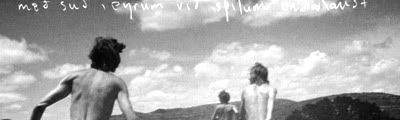 Sigur Rós - Með suð í eyrum við spilum endalaust (2008)
Takk was an album that had a handful of some of the best songs Sigur Rós has ever recorded somewhat marginalized by a handful of some of the worst. Because of this, what was otherwise a smooth transition from epic sad music to upbeat pop songs was viewed as a step back for the band. With Með suð í eyrum við spilum endalaust (I've yet to even bother trying to pronounce this, and in future conversations will just refer to it as "the newest one" or "the one with the naked dudes on the cover.") they don't seem to try to reinvent themselves as much as they try to do Takk again the right way. An effort that, for the most part, has mixed results.
"Goobledigook" sets the tone for the first half of the album and feels like a natural transition from the sound established on Takk. And just to make sure you're aware that their new sound is here to stay, at three minutes long, it's their shortest song with lyrics but is still loaded with the most beats per minute of anything they've previously done. Surprisingly, it doesn't feel too out of character. Though there are Animal Collective comparisons floating around, no one familiar with the band would mistake this for anyone but Sigur Rós. The following three songs are nice enough but fail to make much of an impression. In comparison to similar songs from Takk like "Hoppípolla" and "Gong", they don't really stand out or give you goosebumps; they merely transition and move the album along. Which isn't necessarily a bad thing as it works well for the album experience as a whole, but I can imagine skipping them on a randomized playlist.
What Með suð does better than Takk, though, are with the longer songs. While Takk's longer tracks -- outside of the excellent "Sé Lest" -- suffered from being too formulaic for their own good, Með suð's longer songs, including "Festival" and "Ára bátur," don't fall off track so easily. The difference isn't necessarily in the formula, as the crescendo's are quite predictable, but simply in the fact that they don't sound as forced and tacked on (pun avoided; +10 points to xoxobra).
The latter half of the album slows the flow down considerably, for the most part abandoning the upbeat sound of the first half. It may annoy people who wish the band would do something different and stick with it, but I'm fine with the Sigur Rós that goes for achingly beautiful sounds. By doing so, they compromise and give both types of fans what they want.
As mentioned above, this albums works best when listened to all together, which will lead to vastly different opinions on how good or bad the album is. To put it in concrete terms: I don't think they'll ever make another album as good as Ágætis Byrjun (probably one of my top three of all time), and they don't get much closer with this one. But still, I'm not going to fault them for at least trying to move forward.
Score: 6/10
"Gobbledigook"
"Fljótavík"
Tuesday, September 23, 2008
Dengue Fever - Venus On Earth (2008)
 Dengue Fever - Venus On Earth (2008)
I'm glad Dengue Fever are getting more popular. I can tell this because a Google search for their name actually brings up the band's MySpace near the top of the page, directly below images and information on the actual disease. That's a huge step up from a couple of years ago when they were delegated to the ass end of the search results.
So they have this new album now, and it's not too shabby. The band gives us more Cambodian-flavored pop music with a number of songs performed in singer Chhom Nimol's native language, Khmer. The really exotic, somewhat snaky intonation of the language on top of her already beautiful voice gives the music real flavor, so much so that when singer/guitarist Zac Holtzman contributes English vocals on a few tracks, the album tends to falter. Which raises the question: why ruin a good thing? Nimol is one of the most unique voices in modern rock. Holtzman, while not a bad singer by any means, would better serve the band by sitting back and letting her do her thing.
Musically, Venus on Earth maintains an upbeat pop tempo with a surf rock/spy music kind of feel. Personally, I was hoping for a little more progression into the psychedelic territory they've explored previously. Instead, they've given us more of the same and taken no significant steps forward or backward, which is both good or bad depending on how you approach it. The hooks are still there, so I'm happy. They aren't as huge as they were on their last album, but trying to outdo those hooks would've been asking too much, and I'm just not that selfish. It's good music nonetheless. Interested parties should check out the band's previous album Escape From Dragon House first, though, and then give this one a shot if you're left wanting more.
Score: 7/10
"Clipped Wings"
"Laugh Track"
Tuesday, September 16, 2008
Dead Meadow - Old Growth (2008)
 Dead Meadow - Old Growth (2008)
If I were to use a sports analogy to describe Dead Meadow, I'd say that they're like the Tim Duncan of modern rock. That is to say -- for the benefit of those who care less about sports or the NBA in particular -- Dead Meadow are one of the most consistent and reliable bands in modern rock. All of their efforts up to this point have been at least solid if not exceptional. There was very little doubt in my mind that Old Growth would continue to adhere to that consistency, and I was delighted, though not surprised, to find a strong set of new material presented here.
The repetitive seven minute stoner anthems of their past albums are even further behind them now, as Old Growth picks up where Feathers left off and finds the band trying to perfect the art of the four minute song. While at first it seems like the band are too eager to get things over with, the songs start to feel just right with repeated listens. The back to back to back to back combination of "Down Here" through "Seven Seers" is one of the best groups of songs that we're likely to experience all year. The mood of the album is decidedly more down home and folky than past efforts, which the band actually executes well even though I've always been a fan of their repetitive, droning, psychedelic wall of sound.
All in all, it's a good record that's not immediately impressive but ultimately rewarding over time. I guess they call these types of albums growers. The irony of this description and the album title should not be lost on anyone.
Score: 7.5/10
"I'm Gone"
"Seven Seers"

 Posts
Posts


